
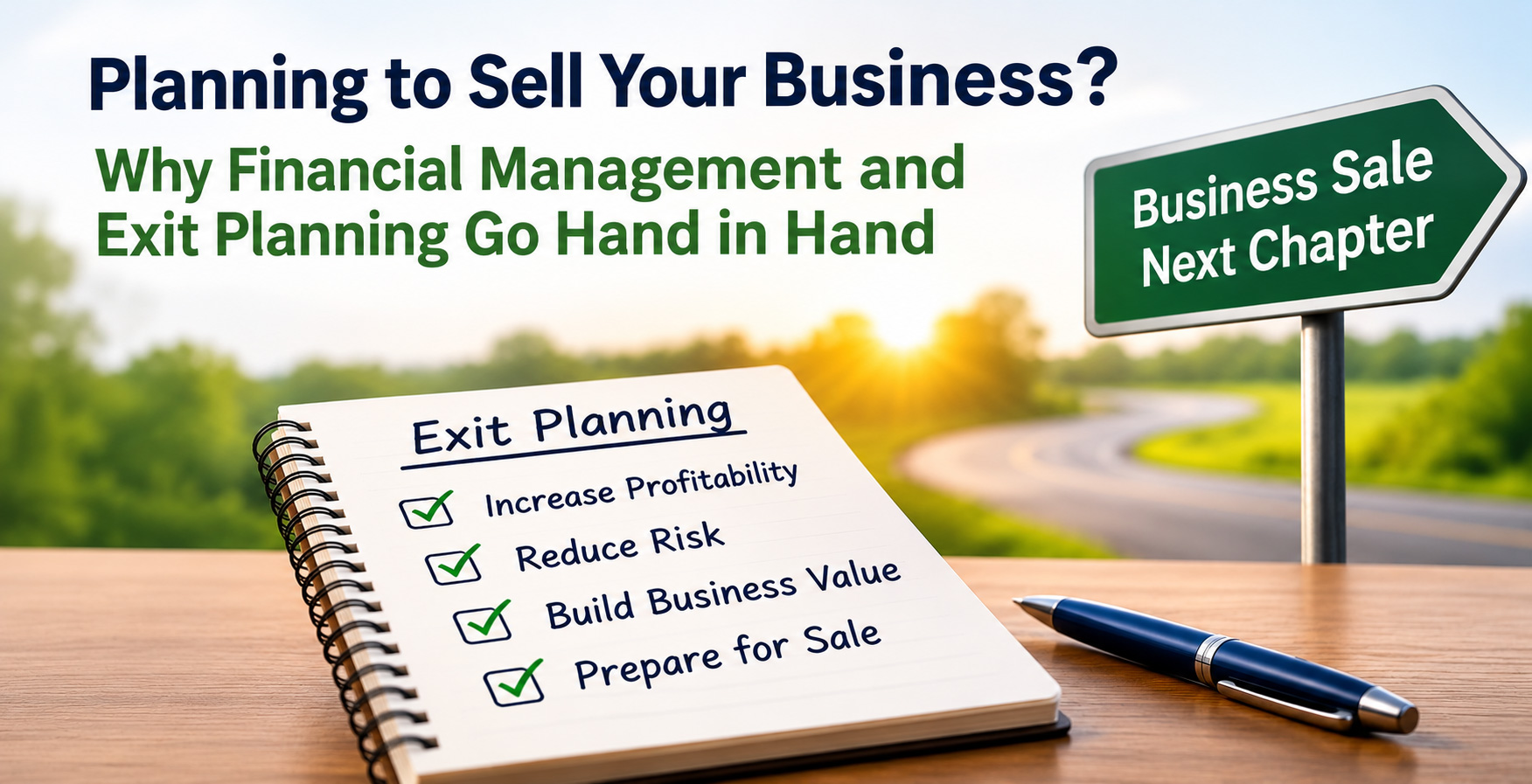
You’ve spent years building your business. You’ve invested time, money, and energy into making it successful. But have you thought about what will happen when you’re ready to move on?
Whether you plan to sell your business next year or five years from now, the decisions you make today can have a significant impact on its future value.
That’s where two important areas of expertise come together: Fractional CFO services and M&A exit planning.
While each serves a different purpose, they complement one another. Together, they can help you strengthen your company’s financial performance, identify opportunities to increase its value, and prepare for a future sale.
What Does a Fractional CFO Bring to the Table?
A Fractional CFO provides experienced financial leadership without the cost of hiring a full-time CFO.
But the role goes well beyond reviewing financial statements.
A Fractional CFO helps business owners understand what’s driving profitability, where cash is going, and how today’s decisions will affect tomorrow’s financial performance.
That includes:
- Improving financial reporting and forecasting.
- Identifying opportunities to increase profitability and cash flow.
- Evaluating expenses, margins, and operational efficiency.
- Developing financial strategies to support growth.
- Identifying financial risks and addressing weaknesses.
- Preparing reliable financial information for lenders, investors, and prospective buyers.
These services help business owners make better financial decisions today. They also establish a stronger financial foundation for a future sale.
After all, prospective buyers aren’t simply interested in how much revenue your company generates. They want to understand its profitability, cash flow, growth potential, and financial risks.
What Does a Certified M&A Exit Planning Advisor Do?
Selling a business involves more than finding a buyer and agreeing on a price.
A Certified M&A Exit Planning Advisor helps business owners prepare for that eventual transaction by evaluating the business from a potential buyer’s perspective and developing strategies to improve its marketability and value.
This may include:
- Assessing the company’s readiness for a sale.
- Identifying factors that could increase or reduce its value.
- Evaluating potential business valuation considerations.
- Developing strategies to address financial and operational risks.
- Reducing dependence on the owner or a small number of key customers.
- Establishing an exit planning strategy aligned with the owner’s financial and personal goals.
- Helping coordinate preparations with legal, tax, valuation, and transaction professionals.
An important part of exit planning is identifying issues that could discourage buyers, reduce the purchase price, or complicate a transaction.
And the earlier those issues are identified, the more time an owner has to address them.
How Do Fractional CFO Services and M&A Exit Planning Work Together?
Here’s where the real value comes in.
A Fractional CFO focuses on strengthening the company’s financial performance and providing the information needed to make sound business decisions.
An M&A Exit Planning Advisor looks at the business through the lens of a future sale, identifying what may make it more attractive and valuable to prospective buyers.
Together, these services connect financial management with long-term business value.
Consider three examples.
- Improving Profitability
Your Fractional CFO identifies declining margins and recommends changes to pricing, expenses, or operations.
Your M&A Exit Planning Advisor evaluates how those improvements could affect the company’s attractiveness to buyers and its potential valuation.
The result? You’re not simply improving this year’s profits. You’re also working to strengthen the value of the business you’re building.
- Reducing Business Risk
Suppose 40% of your company’s revenue comes from one customer.
Your Fractional CFO can help analyze the financial exposure and develop forecasts showing how losing that customer would affect the business.
Your M&A Exit Planning Advisor can assess how that customer concentration might influence buyer interest, valuation, and transaction terms.
Together, they can help you develop a strategy to reduce that risk before it becomes an obstacle to a sale.
- Preparing for Buyer Due Diligence
When a buyer expresses interest, they’ll want detailed financial information to evaluate your business.
Your Fractional CFO helps ensure that your financial statements, forecasts, and supporting records are accurate, organized, and readily available.
Your M&A Exit Planning Advisor helps identify the financial and operational issues buyers are likely to scrutinize, so you can address potential concerns before negotiations begin.
The result is a business that’s better prepared for the questions, scrutiny, and demands of a potential transaction.
Why Start Exit Planning Before You’re Ready to Sell?
One of the biggest mistakes business owners make is waiting until they’ve decided to sell before thinking seriously about exit planning.
By then, there may be limited time to address issues that affect the company’s value.
For example:
- Financial reporting may be inconsistent or incomplete.
- Profitability may be lower than it could be.
- Too much of the business may depend on the owner.
- Revenue may be concentrated among a few customers.
- Important financial or operational processes may not be documented.
These problems generally can’t be corrected overnight.
Starting early gives you the opportunity to make meaningful improvements, demonstrate consistent financial performance, and approach a future sale from a stronger position.
And even if you ultimately decide not to sell, those improvements can make your business more profitable, efficient, and resilient.
Two Areas of Expertise. One Coordinated Strategy.
At The A Team Consulting, we understand that running a successful business and preparing for a successful exit aren’t separate objectives.
They’re closely connected.
Our Fractional CFO services help business owners manage financial performance, improve profitability, and plan for growth.
And with a Fractional CFO on our Team who is also a Certified M&A Exit Planning Advisor, we can bring both perspectives to the table, helping clients evaluate their financial performance in the context of their long-term ownership and exit goals.
That combination is especially valuable because decisions about profitability, cash flow, operational risk, and growth can directly affect the value of a business when it’s time to sell.
You don’t have to be ready to sell to benefit from exit planning. In fact, the best time to start may be while you’re still focused on growing your business.
How Ready Is Your Business for Its Next Chapter?
Whether you’re considering a sale in the near future or simply want to understand what your business might be worth down the road, knowing where you stand is a good place to start.
Download The A Team Consulting’s free M&A Readiness Scorecard to identify areas of your business that may need attention before a future sale.
Or contact The A Team Consulting to discuss how our Fractional CFO and M&A exit planning expertise can help you strengthen your business today while preparing for tomorrow’s opportunities.
Frequently Asked Questions About Business Exit Planning
When should I start planning to sell my business?
Ideally, business owners should begin exit planning at least 12–24 months before a potential sale, although starting earlier can provide additional advantages. This allows time to improve profitability, strengthen financial reporting, reduce business risks, and address issues that could negatively affect the company's value. Even if you don't have a specific sale date in mind, early planning can help position your business for a more successful exit.
How can a Fractional CFO help prepare my business for sale?
A Fractional CFO helps prepare a business for sale by improving financial reporting, strengthening cash flow, identifying opportunities to increase profitability, and organizing the financial information prospective buyers will review. By providing experienced financial leadership and forward-looking analysis, a Fractional CFO can help business owners make decisions that improve current performance while building long-term business value.
What does a Certified M&A Exit Planning Advisor do?
A Certified M&A Exit Planning Advisor helps business owners evaluate their readiness for a future sale and develop strategies to improve the company's value and marketability. This includes identifying financial and operational risks, assessing factors that influence business valuation, reducing owner dependency, and coordinating preparations with other transaction professionals. The goal is to help owners approach a potential sale with greater confidence and preparation.
What factors have the greatest impact on the value of a business?
Several factors can influence a company's value, including profitability, cash flow, revenue growth, customer concentration, operational efficiency, and financial reporting accuracy. Buyers also consider how dependent the business is on its owner, the strength of its management team, and its potential for future growth. Addressing weaknesses in these areas before a sale can help make the business more attractive to prospective buyers.
Do I need a full-time CFO to prepare my business for sale?
No. Many small and midsize businesses can benefit from Fractional CFO services without hiring a full-time financial executive. A Fractional CFO provides experienced financial guidance, including forecasting, profitability analysis, financial reporting, and due diligence preparation, on a flexible basis. This allows business owners to access strategic financial expertise while managing costs.
How do I know if my business is ready to sell?
A business may be better positioned for sale when it has reliable financial statements, consistent profitability, predictable cash flow, documented processes, and limited dependence on its owner or a small number of customers. However, financial performance alone doesn't determine sale readiness. An M&A readiness assessment can help identify potential weaknesses, evaluate risks, and highlight areas that may need attention before approaching prospective buyers.